Tuesday, December 28, 2010

Happy Holidays 2010

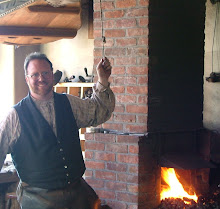
As we head through December toward the New Year snow has been falling and the days are getting shorter and darker.  The wood stove in the Blacksmith shop makes a cheerful smoke plume in the morning.


Each day we light the wood stove and also the coal forge.  Here the coal fire is just starting to burn well. 


Happy Holidays and best wishes for a safe, happy, and prosperous New Year! 

Wednesday, December 15, 2010

Weathervane Project: Part I

The Peleg Field Blacksmith Shop at The Farmers’ Museum is building a Weathervane. This isn’t our first weathervane project, but it will be the largest and most detailed.  A Weathervane made in the Field shop sits atop our own roof! The weathervane features a running horse of copper held by a forged steel armature. With a flowing mane and tail held high, it is a good mascot for our shop. This weathervane is not an artifact from the past.  It was made in the last decade by a highly skilled Blacksmith and volunteer at our shop.


An ongoing project has been to make a Weathervane based upon the original on the New York State Historical Association Research Library. The NYSHA weathervane was made in the late 1960’s. Its signature element is the beautiful copper quill that is the vane.  The quill is all made of worked brass and copper.  It shows a masterful touch with detail.
At the Peleg Field shop we have been working on a reproduction of the NYSHA weathervane. It is a formidable task due to the detail and size of the project. As the project continues we will have more installments on the Weathervane Project!

Weathervanes were a specialized item made by skilled craftspeople.  If you appreciate the artistry and whimsy present in weathervanes then check out the blog from our sister institution, the Fenimore Art Museum.  There are some amazing weathervanes shown in discussions on American Folk Art.

Thursday, December 2, 2010

“T’was the Night before Christmas” –Making Christmas in the 19th Century.

The Farmers' Museum reopens to the public on Saturday, December 11th for Candlelight Evening.  Since we are preparing to celebrate the season in 19th century style, I thought it would be appropriate to revisit the poem that helped to define Christmas as an American secular holiday.

Clemet Clark Moore was a scholar, a published author of literary translation, and a poet. He seems to have been a serious and scholarly man of wealth, privilege, and influence. It is intriguing that this man of gravitas and serious mein is attributed the poem that helped solidify and define the American Christmas tradition of the 19th century.

A Visit from St. Nicholas
'Twas the night before Christmas, when all thro' the house
Not a creature was stirring, not even a mouse;

The stockings were hung by the chimney with care,
In hopes that St. Nicholas soon would be there;
The children were nestled all snug in their beds,
While visions of sugar plums danc'd in their heads,

And Mama in her 'kerchief, and I in my cap,
Had just settled our brains for a long winter's nap —
When out on the lawn there arose such a clatter,
I sprang from the bed to see what was the matter.

Away to the window I flew like a flash,
Tore open the shutters, and threw up the sash.
The moon on the breast of the new fallen snow,
Gave the lustre of mid-day to objects below;

When, what to my wondering eyes should appear,
But a miniature sleigh, and eight tiny rein-deer,
With a little old driver, so lively and quick,
I knew in a moment it must be St. Nick.

More rapid than eagles his coursers they came,
And he whistled, and shouted, and call'd them by name:
"Now! Dasher, now! Dancer, now! Prancer and Vixen,
"On! Comet, on! Cupid, on! Donder and Blitzen;
"To the top of the porch! To the top of the wall!
"Now dash away! Dash away! Dash away all!"

As dry leaves before the wild hurricane fly,
When they meet with an obstacle, mount to the sky;
So up to the house-top the coursers they flew,
With the sleigh full of toys — and St. Nicholas too:

And then in a twinkling, I heard on the roof
The prancing and pawing of each little hoof.
As I drew in my head, and was turning around,
Down the chimney St. Nicholas came with a bound:

He was dress'd all in fur, from his head to his foot,
And his clothes were all tarnish'd with ashes and soot;
A bundle of toys was flung on his back,
And he look'd like a peddler just opening his pack:

His eyes — how they twinkled! His dimples: how merry,
His cheeks were like roses, his nose like a cherry;
His droll little mouth was drawn up like a bow,
And the beard of his chin was as white as the snow;

The stump of a pipe he held tight in his teeth,
And the smoke it encircled his head like a wreath.
He had a broad face, and a little round belly
That shook when he laugh'd, like a bowl full of jelly:

He was chubby and plump, a right jolly old elf,
And I laugh'd when I saw him in spite of myself;
A wink of his eye and a twist of his head
Soon gave me to know I had nothing to dread.

He spoke not a word, but went straight to his work,
And fill'd all the stockings; then turn'd with a jerk,
And laying his finger aside of his nose
And giving a nod, up the chimney he rose.

He sprung to his sleigh, to his team gave a whistle,
And away they all flew, like the down of a thistle:
But I heard him exclaim, ere he drove out of sight
Happy Christmas to all, and to all a good night.
—Clement Clark Moore

The poem was first published in 1823 in The Sentinel newspaper of Troy, NY, and was immensely popular by 1845. There was even debate over whether Moore was really the author. That stems in part from the initial publishing being done anonymously. Moore included the poem in an anthology of his work published in 1844.

The light and cheerful poem is quite different from his more scholarly and serious writing. He noted that it was written for his children, and only published at their insistence. Not only does this poem provide a glimpse into the development of American conceptions of Christmas as a secular holiday, but also an unexpected glimpse into the home life of a scholarly and private 19th century gentleman.

Warm holiday wishes from all of us at The Farmers' Museum.

Tuesday, November 23, 2010

Mending Farm Tools at the Blacksmith Shop

Every tool that is used at the Lippitt Farmstead can wear and need mending. Some of the agricultural tools used with our horse and oxen at The Farmers' Museum have been in use since James K. Polk was President! At the Peleg Field's Blacksmith Shop, we use the same traditional metalworking methods to repair the farm equipment as was used in their original construction.

Recently, the seed roller was brought to the shop by our ox team Jigs and Buckwheat.  It had a broken metal bracket.  We removed the bracket and began repairs.
The broken bracket had new steel forge-welded in place.  Then the bolt holes were punched, and the bracket bent to the proper shape.  That should be as good as new!
Horse drawn farm equipment often had parts that deteriorated throug use and were designed to be replaced.  Unfortunately for us, sometimes the company that made the replacement part has been out of business for a century!  We can usually figure out how to make the needed part at the Blacksmith Shop.  Over the course of a year we have done major repairs on the plow and the seed roller, and smaller repairs on the spring tooth harrow, ox cart, and ox yoke.  This illustrates to us how necessary the Blacksmith would have been to a farmer in the 19th century.

Monday, November 15, 2010

Draft Power: Fall work for the oxen.

Fall is a busy season for the farmers at The Farmers’ Museum. The last of the late summer crops are cleaned up and cleared from the fields. Our draft animals get used for a wide variety of work. Cutting corn stalks and hauling crops to the barn for the winter is one large job.
Oxen hauling corn:

Our oxen have also been busy hauling other crops. They have hauled the fall pumpkin and mangle wetzel (fodder beets) to the barn for winter cattle feed. The oxen also played a major part in our Tractor Festival in October to haul oats from the barn to the threshing machine, and then take the straw and cleaned oats back to the barn.

Oxen hauling oats:
Another essential task is to clean up the fields, plant fall crops, and prepare for the future. The ground in the fields needs to be plowed and harrowed to prepare for the next spring’s growing season. These activities plow under and composts crop stubble and prepare the soil for the next crop. Jigs and Buckwheat (the oxen) have pulled the plow and the harrow to condition the soil and make a smooth seedbed.
This fall our main field is planted to winter wheat. This hardy crop sprouts quickly in the fall and develops strong roots before the arrival of winter snow. It stays alive but dormant through the winter.

In the spring ,when the snow melts, these winter cover crops grow quickly. They can be grown to full harvest before any other crop is ready. The oxen will be used then to haul shocks of wheat in from the field, and to again plow the field for the next crop.

Jigs and Buckwheat at Field's Blacksmith Shop:
Jigs and Buckwheat have been put to hard work this fall.  They are now fully grown, and are learning to do real work.  They have plowed, harrowed, and rolled the fields and have done their duty hauling crops to the barn.  You could say they have been pulling their own weight around the farm!  Our next blog will look at the repairs we have done to the farm equipment at The Farmers' Museum in Field's Blacksmith Shop!

Tuesday, November 9, 2010

A Blacksmithing Conference: The SOFA Quad-State Roundup!

Where do blacksmiths go on vacation? To a blacksmith’s conference of course! The largest annual Blacksmithing conference in the U.S. is held in late September each year by the Southern Ohio Forge and Anvil blacksmithing group. The conference is call the Quad-State Roundup, and is held at the Miami County Fairgrounds in Troy, Ohio.


One of the attractions to the event is the sale of new and old tools. Hundreds of blacksmiths and tool collectors bring items to sell off the tailgate of their trucks or trailers.  There were more old anvils, old tools, and new blacksmithing tools in one place than I had ever seen before.


The blacksmithing demonstrations are the heart of this event. Each year it has four presenters demonstrating traditional ironworking, bladesmithing, architectural ironwork, and artistic smithing. Each year there are different demonstrators doing work of the highest quality.   The 2010 Demonstrators were Marsha Nelson, J.W. Randall, Caleb Kullman, and Whitney Potter. 

Caleb Kullman Demonstrating:
This year the SOFA organization dedicated a new stone and brick forge in the Traditional Blacksmithing building. The featured demonstrator was Marsha Nelson, a very talented blacksmith from Kentucky. The Farmers’ Museum is very proud to say that she is an alumna of our shop and worked with Master Smith Paul Spaulding in the early 1980s.  Here is Marsha, the first demonstrator to use the newly dedicated forge:

Marsha’s demonstration guided the watchers through the making of forged cooking utensils. Spatulas, forks with flow-in brass ornamentation, and ladles were demonstrated.  She was a very popular demonstrator, and the three sets of bleacher in the workshop were often full.

Marsha demonstrated forging a cooking fork:


She brought to the demonstration a piece made during her time at The Farmers' Museum, complete with our shop touchmark:
Skimmer with beautiful pierced brass bowl:

Spatula with flow-in brass ornamentation:

The conference never seems long enough to see everything.  In addition to the tailgate sales and the wonderfully organized blacksmithing demonstrations, the conference is a place of great comraderie among smiths.  I renewed old friendships and met a lot of people.

My thanks to the Southern Ohio Forge and Anvil and the dozens of volunteers that make the Quad State Roundup such a wonderful yearly event.

Tuesday, November 2, 2010

2010 Tractor Festival at The Farmers' Museum

Columbus Day Weekend of 2010 saw a new event at The Farmers’ Museum. For almost 70 years our Museum has been preserving and demonstrating aspects of farm life in the 19th century. But now the 20th century is also part of our nation’s history. The new Tractor Festival showcases the tools, methods, and equipment used in the last century on American farms.

The day dawned frosty and cold.  Columbus Day happened to fall on 10/10/2010!


Our Farmers outdid themselves. Oxen Jigs and Buckwheat hauled tons of oats from the barn to the thresher.  The day could not have been more beautiful.


The Rumsey Williams wooden threshing machine was made in nearby St. Johnsville. For several hours each day the Farm staff and volunteers threshed oats from the straw. The oats were bagged for animal feed and the straw returned to the barn.


Dozens of volunteers brought their restored classics and working modern tractors and farm machines. There were too many to show them all here, but they ranged from machines made in the 1930s to the present.


A John Deere was present with a restored two-row corn picker! This machine attached all around the tractor and allowed it to pick field corn from stalks standing in the field! These were complex machines, and now are replaced by combines and corn choppers. It was great to see an example of this tool survive.


The largest tractor was a the local Cooperstown Holstein Corporation's John Deere with grain wagon. It was almost as big as our Farmhouse!

Tractor Festival will be an annual event. Be sure to join us on Columbus Day Weekend 2011 (October 8 and 9) for an even more exciting event.
Blog Widget by LinkWithin